
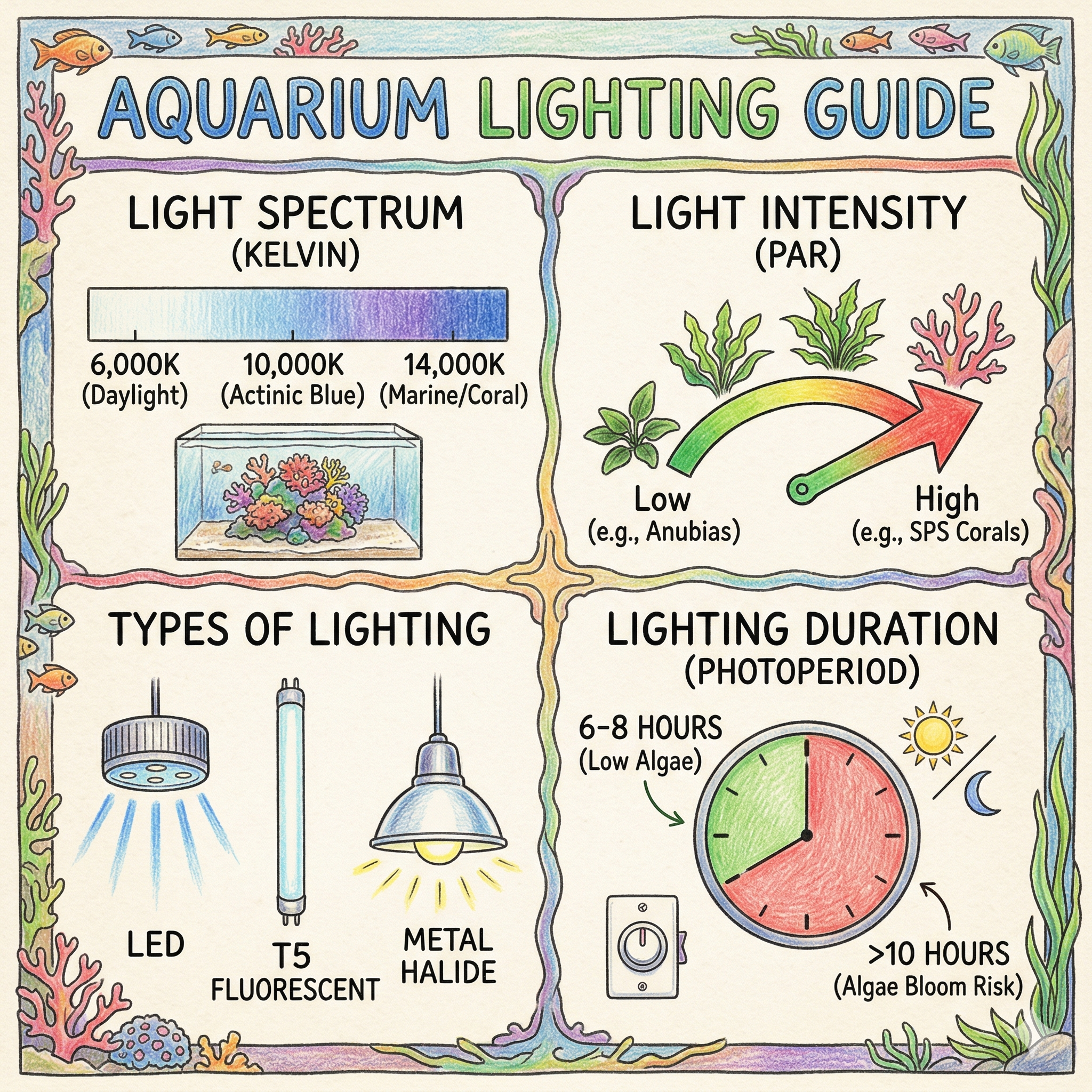
Aquarium Lighting Guide
Aquarium lighting looks simple until you start shopping. One fixture promises “full spectrum planted growth,” another brags about app-controlled sunrises, and another focuses purely on color pop for fish. Beginners often end up buying more light than their tank actually needs — and then fight algae for months.
In my tanks in Norman, Oklahoma, I’ve learned this lesson the hard way. My first betta tank had a cheap overly-bright LED that looked great for a week but triggered constant green water and thread algae. Switching to a moderate, timer-controlled light changed everything: healthier plants, clearer water, and far less maintenance stress.
This 2026-updated guide gives you practical, experience-based advice so you choose lighting that makes your tank enjoyable instead of frustrating.
Aquarium Lighting at a Glance
| Lighting Goal | Best Beginner Approach | Why It Works | Main Risk |
|---|---|---|---|
| Basic fish-only display | Moderate LED with timer | Great visibility, low hassle | Overlighting triggers algae |
| Low-maintenance planted tank | Adjustable planted LED, moderate level | Supports easy plants reliably | Too much light = imbalance |
| Small office tank | Low-heat, timer-controlled LED | Predictable routine & quiet | Forgetting to turn off lights |
| Advanced planted aquascape | Controllable high-output fixture | Strong plant growth & color | Higher cost & maintenance |
What Aquarium Lighting Actually Does
Lighting has two main jobs:
- Make the tank look beautiful and colorful for you
- Support live plants (if you have them)
These goals don’t always need the same power. A fish-only or artificial-plant tank looks excellent under moderate light. Planted tanks need more careful balancing.
Key principle I now follow: Use only as much light as the tank actually needs. More light almost always means more maintenance unless everything else (nutrients, CO₂, plant mass) keeps up.
The Three Core Concepts Beginners Must Understand
1. Intensity (Brightness)
How strong the light feels inside the tank.
Beginner rule: Start lower than you think you need.
- Low–moderate intensity works great for most home/office tanks.
- High intensity is only for serious planted displays with strong maintenance habits.
2. Spectrum (Color Quality)
The mix of wavelengths.
For most freshwater tanks, a good full-spectrum aquarium LED is all you need. You don’t have to obsess over PAR charts or Kelvin ratings as a beginner.
3. Duration (Photoperiod)
How many hours the light stays on each day.
This is where most tanks quietly fail. Even moderate light causes algae problems if left on 12–14+ hours.
My safe starting point: 6–8 hours per day.
Best Lighting Recommendations by Tank Type (2026)
Fish-Only or Artificial Plant Tanks
- Moderate LED strip or clip-on light
- Timer essential
- Low heat output
- Good color rendering (CRI 80+)
Low-Maintenance Planted Tanks
- Adjustable planted LED (e.g., Finnex, Fluval, or Chihiros-style)
- Start at 50–70% brightness
- Consistent 7–8 hour schedule
Office Tanks
- Quiet, low-heat LED with reliable timer
- Shorter photoperiod (6–7 hours) to match work schedule
Advanced Planted Tanks
- Higher-output controllable fixtures
- Only after you’re confident with nutrients and maintenance
2026 Popular Beginner-Friendly Lights
| Budget Level | Recommended Fixtures | Best For | Approx. Price |
|---|---|---|---|
| Low | Basic Nicrew / Hygger LED | Fish-only, betta, nano | $15–40 |
| Mid | Fluval Plant 3.0 or Finnex FugeRay | Low-tech planted | $50–120 |
| Higher | Chihiros WRGB II or Twinstar | Serious planted displays | $150–350+ |
How Lighting Affects Algae (And How to Stay Ahead)
Excess light is one of the top causes of algae in beginner tanks.
Common mistakes I’ve made:
- Leaving lights on while at work + natural window light
- Using a high-output planted light on a low-plant tank
- Constantly changing intensity or schedule
Quick fix when algae appears: Drop duration by 1–2 hours first — often solves the issue without buying anything new.
Timers: The Most Important Lighting Accessory
A simple timer ($8–15) is one of the highest-ROI upgrades you can make.
It creates consistency for fish, plants, and algae control — especially valuable in office or busy-home setups.
Step-by-Step: How to Choose Your Lighting
- Decide your tank’s main purpose (fish display? low-tech plants? office?)
- Measure your tank length and depth
- Choose moderate intensity first
- Prioritize timer support
- Buy once, set consistently, and adjust slowly based on results
Common Lighting Mistakes (Learn From My Tanks)
- Buying the brightest light available
- No timer — turning lights on/off manually every day
- Ignoring ambient room light
- Changing settings too frequently
- Over-lighting a low-maintenance setup
The Bottom Line
For most home and office aquariums in 2026, the best lighting is a moderate, timer-controlled LED matched to your actual plants and lifestyle. Start conservative, keep the schedule consistent, and let the tank tell you when (or if) it needs more.
Ready to choose?
Use the Aquarium Wizard for personalized lighting suggestions based on your tank size and goals.
Or read my Complete Beginner Tank Setup Guide next.
Keep moving from reading to action.
Use the related guides to go deeper, check the shop if you need matching accessories, or join the email list for new guides and product updates.
Get new guides, product updates, and practical aquarium planning notes by email without waiting to check back manually.
Use the contact page if you want direct help instead of general email updates.
Related Guides
Aquarium Filter Types Explained
Compare sponge, hang-on-back, canister, internal, and undergravel filters so you can choose the right aquarium filtration system for your tank size, fish, budget, and maintenance style. Real lessons from tanks in Norman, Oklahoma.
Aquascaping Basics: Creating Stunning Underwater Landscapes
Learn practical beginner aquascaping rules for home and office tanks — focal points, negative space, hardscape, plant grouping, and layouts that look intentional instead of cluttered. Real lessons from tanks in Norman, Oklahoma.
Complete Beginner Tank Setup Guide 2026
Step-by-step instructions for setting up your first home or office aquarium — from choosing equipment and location to cycling, stocking, and long-term success. Real lessons from tanks in Norman, Oklahoma.